Table of Contents
- Introduction
- Understanding Artificial Intelligence in Modern Life
- AI in Communication and Personal Technology
- AI in Education and Learning
- AI in Healthcare and Wellness
- AI in Business and the Workplace
- AI in E-Commerce and Retail
- AI in Transportation and Navigation
- AI in Entertainment and Media
- AI in Finance and Banking
- AI in Smart Homes and Daily Living
- Ethical Challenges and Responsible AI Use
- The Future of AI in Everyday Life
- Conclusion
Introduction
Artificial intelligence has rapidly evolved from a futuristic concept into a practical technology embedded in everyday experiences. Artificial Intelligence in Modern Life is no longer limited to laboratories or tech companies—it actively shapes how people communicate, learn, work, shop, travel, and manage their health.
From unlocking smartphones using facial recognition to receiving personalized content recommendations, AI systems operate quietly in the background, improving efficiency and convenience. By analyzing massive amounts of data and learning from patterns, AI enables machines to perform tasks that traditionally required human intelligence.
This article explores how artificial intelligence impacts modern life across various sectors, highlighting its benefits, applications, and the responsibilities that come with its widespread adoption.
Understanding Artificial Intelligence in Modern Life
Artificial intelligence refers to computer systems designed to simulate human intelligence processes such as learning, reasoning, problem-solving, and decision-making. These systems rely on technologies like machine learning, natural language processing, and computer vision.
In modern society, AI is integrated into tools and platforms people use daily. Whether consciously or not, individuals interact with intelligent systems multiple times a day, making AI an essential component of contemporary living.
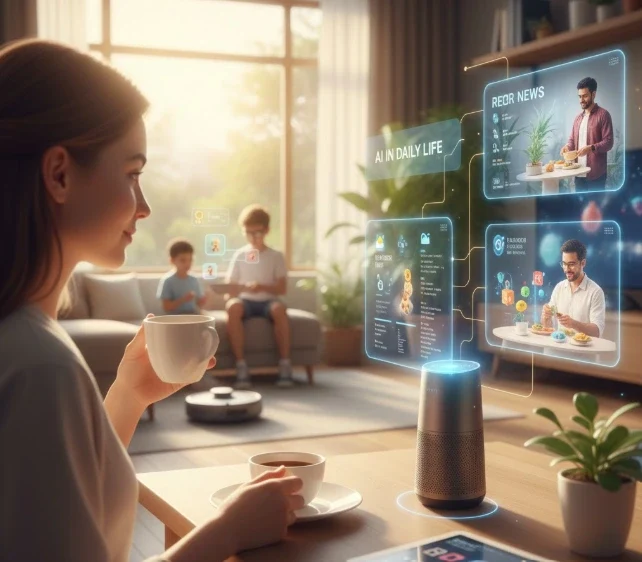
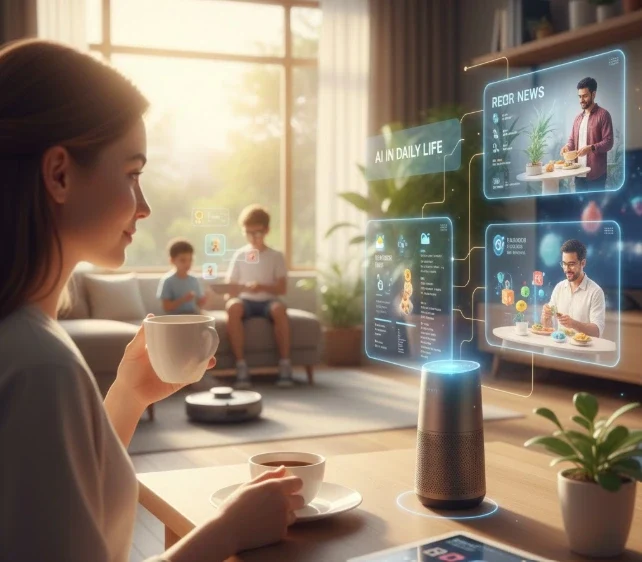
Alt text: Artificial Intelligence in Modern Life improving daily activities
AI in Communication and Personal Technology
Smartphones and Digital Assistants
Smartphones are among the most common examples of AI-powered devices. Features such as facial recognition, voice commands, predictive typing, and camera enhancements are driven by artificial intelligence.
Virtual assistants use advanced language processing to understand spoken commands and provide relevant responses. They help users schedule appointments, set reminders, search information, and manage smart home devices. Over time, these assistants learn user preferences, offering increasingly personalized interactions.
Email and Messaging Platforms
AI enhances digital communication by filtering spam, detecting phishing attempts, and prioritizing important messages. Smart reply features analyze message context to suggest quick responses, saving time and effort.
Email platforms also use AI to organize inboxes into categories, improving productivity and reducing information overload.
AI in Education and Learning
Personalized Learning Experiences
Educational platforms increasingly rely on AI to deliver customized learning paths. By analyzing student performance and engagement, AI systems adapt content difficulty and pacing to match individual needs.
This personalization helps students grasp concepts more effectively and encourages continuous learning, regardless of location or background.
Automated Assessment and Feedback
AI-powered assessment tools automate grading for quizzes and assignments, providing instant feedback. This allows learners to identify strengths and weaknesses quickly while reducing teachers’ administrative workload.
AI is also used to detect plagiarism and improve content evaluation, supporting academic integrity.
Internal resource:
Learn more about educational technology on our guide to digital learning solutions
AI in Healthcare and Wellness
Medical Diagnosis and Decision Support
Healthcare is one of the most impactful areas of artificial intelligence adoption. AI systems analyze medical images, patient records, and test results to assist doctors in diagnosing diseases more accurately.
These systems help identify patterns that might be overlooked by humans, improving early detection and treatment planning.
Wearable Health Technology
Wearable devices such as fitness trackers and smartwatches use AI to monitor physical activity, sleep cycles, heart rate, and stress levels. Users receive personalized health insights that encourage healthier habits.
AI can also detect abnormal patterns and alert users to potential health risks before they become serious.
Mental Health Applications
AI-powered mental health apps offer guided meditation, mood tracking, and chatbot-based support. While not a replacement for professional care, these tools increase access to mental health resources and promote emotional well-being.
External reference (DoFollow):
Learn about AI in healthcare from World Health Organization resources
AI in Business and the Workplace
Automation of Routine Tasks
In modern workplaces, AI automates repetitive tasks such as data entry, scheduling, invoice processing, and customer inquiries. Automation improves efficiency and allows employees to focus on creative and strategic work.
Data Analysis and Strategic Decisions
AI-driven analytics tools process large datasets to uncover trends and insights. Businesses use these insights for market analysis, customer behavior prediction, and performance optimization.
Predictive models help organizations plan for future scenarios and reduce risks.
Human Resources and Recruitment
AI assists in resume screening, candidate matching, interview scheduling, and employee performance analysis. When used responsibly, these systems improve hiring efficiency and reduce unconscious bias.
AI in E-Commerce and Retail
Personalized Shopping Experiences
Online retailers rely on AI-powered recommendation systems to suggest products based on user behavior. This personalization increases customer satisfaction and conversion rates.
Dynamic pricing models also use AI to adjust prices based on demand, competition, and consumer trends.
Inventory and Supply Chain Management
AI optimizes inventory levels by predicting demand patterns. Retailers reduce waste, prevent stock shortages, and improve logistics efficiency through intelligent supply chain systems.
AI in Transportation and Navigation
Smart Navigation Systems
Navigation apps use AI to analyze real-time traffic data and suggest optimal routes. These systems help users save time, reduce fuel consumption, and avoid congestion.
Ride-Sharing and Mobility Services
Ride-hailing platforms depend on AI for route optimization, pricing strategies, and driver-passenger matching. Safety monitoring and demand forecasting further enhance user experience.
Autonomous and Assisted Driving
AI powers advanced driver-assistance features such as lane detection, collision avoidance, and adaptive cruise control. These technologies improve road safety and pave the way for autonomous vehicles.
AI in Entertainment and Media
Content Recommendation Engines
Streaming platforms use AI algorithms to recommend movies, music, and shows based on viewing history. Personalized content keeps users engaged and enhances satisfaction.
Content Creation and Editing Tools
AI assists creators with photo enhancement, video editing, music composition, and writing support. These tools streamline production while maintaining creative flexibility.
Gaming and Virtual Worlds
AI improves gaming experiences through intelligent non-player characters, adaptive difficulty levels, and immersive virtual environments.
AI in Finance and Banking
Fraud Detection and Security
Financial institutions use AI to detect suspicious transactions in real time. Pattern recognition helps prevent fraud and protect sensitive customer information.
Digital Banking Services
AI supports credit scoring, loan approvals, and personalized financial advice. Budgeting apps analyze spending patterns and offer tailored recommendations.
External reference (DoFollow):
Explore AI in finance on IBM’s AI insights platform
AI in Smart Homes and Daily Living
Home Automation
Smart home systems use AI to manage lighting, heating, appliances, and security. These systems learn user habits and adjust settings automatically for comfort and efficiency.
Energy Optimization and Sustainability
AI analyzes energy usage patterns to reduce waste and lower costs. Smart grids and energy management systems contribute to environmental sustainability.
Security and Surveillance
AI-powered cameras and security systems use facial recognition and motion detection to enhance safety in homes and communities.
Ethical Challenges and Responsible AI Use
Despite its benefits, Artificial Intelligence in Modern Life raises concerns about data privacy, algorithmic bias, transparency, and job displacement. Responsible AI development requires ethical guidelines, regulations, and human oversight.
Balancing innovation with accountability is essential to building trust and ensuring fair use of intelligent systems.
The Future of AI in Everyday Life
As AI technology continues to evolve, its role in daily life will expand further. Future applications may include more advanced healthcare diagnostics, fully autonomous transportation, and highly personalized digital environments.
Understanding AI empowers individuals and organizations to adapt, innovate, and thrive in an increasingly intelligent world.
Conclusion
Artificial intelligence has become a foundational element of modern society. From communication and education to healthcare, business, and entertainment, Artificial Intelligence in Modern Life enhances efficiency, personalization, and decision-making.
While challenges remain, responsible development and ethical implementation can ensure that AI continues to improve the quality of life. As technology advances, embracing AI with awareness and balance will shape a smarter, more connected future.
Leave a Reply